From Ship of Fools to a House of Love
By Karen Sharpe Kramer
My love story with Stanley began long before I ever realized it. When I was sixteen years old, still in high school, I had three little lines in a film called The Sniper. I hardly remembered doing it, a soda fountain scene, a telephone booth, nothing remarkable, but that tiny job paid enough to earn my membership in the Screen Actors Guild. Only years later did it strike me that the film had been produced by Stanley Kramer. He helped launch my career without ever knowing my name.
By the mid-1960s, I had already worked steadily for nearly seventeen years in films, live television, theatre, and more than ninety starring roles on TV. I was ambitious, determined, and proud of the career I had built on my own terms. I had turned down Jerry Lewis several times because I didn’t want to be a simple ingénue or the “straight woman” in someone else’s comedy. After my father passed away unexpectedly and I stepped away from Hollywood for a year to settle his estate, I returned home to find the industry had shifted. Jerry offered to triple my salary, have Edith Head design my wardrobe, and give me top billing, so I finally accepted.
We shot at Paramount Studios. Across the way, Stanley was directing Ship of Fools. I knew his name, of course, but I wasn’t someone who chased celebrity or attention. I stayed focused on my work, living in my own lane. The only person who truly mesmerized me on that lot was Vivien Leigh, whom I saw in the commissary. Vivien Leigh, the luminous star of Gone with the Wind and A Streetcar Named Desire, was unforgettable.
One day, curiosity got the better of me. Between scenes, I gathered my courage and stepped onto Stanley’s closed set. I had never done such a thing, not once in decades of working. But there I was, standing below an enormous ocean liner built inside the soundstage, watching Vivien Leigh rehearse.
Stanley spotted me immediately. “Who is that?” he asked, rightfully so, since I was not supposed to be there.
Someone on the crew recognized me and explained I was working across the way. Stanley looked down and said, “All right. She can stay.”
I had no idea that moment would change my life.


A few days later, I learned he had wanted to meet me. I brushed it off. When his office called and said he wished to take me to dinner, I refused. If he wanted to see me, he could meet me across a desk. I wasn’t interested, and I certainly wasn’t going to be charmed. Without realizing it, I was playing “hard to get” in the most authentic way possible. Later I joked that if you want someone, act as if you don’t. I wasn’t trying. I simply didn’t think romance was involved.
For months, he kept asking. For months, I kept saying no.
At last, my manager said she couldn’t keep making excuses. If I wasn’t going to meet him, I would have to tell him myself. So I did, quite directly.
Eventually, I agreed to dinner on my terms: early, modest, and in the San Fernando Valley, which was practically forbidden territory for Hollywood in those days. We met at Tail O’ the Pup in Studio City, a place as casual and unpretentious as I felt the situation needed to be. He hesitated about the Valley, but he came.

I was probably a little cool, perhaps unintentionally. He talked. I listened politely. And at exactly eight o’clock, I stood up and left.
I told my manager, “Well, that’s that.”
Not long afterward, I was hospitalized with a ruptured appendix. To my surprise, Stanley called the hospital to ask if he could bring me dinner once I was home recovering. Out of embarrassment for how I had treated him, I agreed, and invited my dear friend Henry Wilcoxon, a retired silent film star and extraordinary cook, to stop by so I wouldn’t have to carry the conversation while still recuperating.
When Stanley arrived, he and Henry bonded instantly. Henry invited us both to dinner at his home, and during those evenings, surrounded by warmth and conversation, I saw a new side of Stanley.

He wasn’t Hollywood at all. He was shy, sincere, and thoughtful. He was uncomfortable with the politics and power games of the industry. He cared deeply about the world and about people. He believed films could confront injustice, illuminate truth, and change minds.
Somewhere in those dinners, I fell in love.
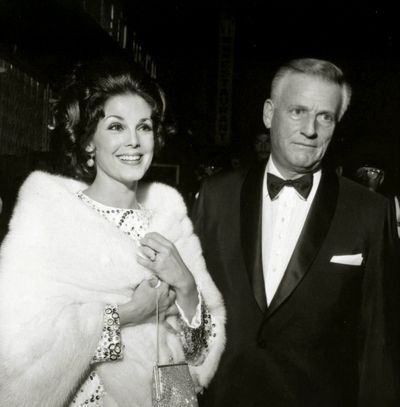
A few months later, we married quietly on September 1, 1966, in the living room of his home. His two children from his first marriage were stunned. He had told them only the night before. My mother was there, as was his uncle. I had never been to his home before that day. I finished shooting The Wild Wild West late the night before, went to my mother’s house to sleep, and by morning, we were at the courthouse getting our license.
We married in front of the fireplace. Seeing the children’s uncertainty, I said, “Does anyone have a bathing suit I can borrow? Let’s go swimming. I’ll make hamburgers.” And that was how our family began.
I eventually stepped away from acting because I chose to. My marriage, my children, and the work Stanley and I could do together mattered more. I became a producer on Guess Who’s Coming to Dinner, uncredited by choice, because I wanted to earn every inch of that title. And I did.
I learned from a man whose films took genuine risks and challenged the world. Stanley had an extraordinary instinct for talent. He worked with, discovered, or elevated some of the greatest performers of our time. He gave unknown or little-known actors their first real break: Marlon Brando, Glenn Ford, Kirk Douglas, Grace Kelly, Sophia Loren, Jose Ferreira, Jonathan Winters, Harrison Ford and many others who would go on to become icons. He didn’t chase stars. He recognized truth in people long before the industry caught up.
His body of work speaks for itself: Champion, High Noon, Judgment at Nuremberg, On the Beach, The Defiant Ones, Ship of Fools, It’s a Mad, Mad, Mad, Mad World, and the film that helped change laws allowing interracial marriage, Guess Who's Coming to Dinner? Stanley was an independent spirit, uninterested in Hollywood politics, and devoted to stories of justice and injustice. In many ways, we were two strong-minded outsiders who found each other at exactly the right moment.
When he became ill, my daughter, Jennifer, cared for him with extraordinary devotion. She shouldered much of the day-to-day, a responsibility far beyond her years. Eventually, I brought him to the Motion Picture and Television Fund Home so we could spend his final year as a family instead of full-time caregivers. Those months were tender and peaceful.
He passed at eighty-seven. Even when expected, loss never arrives gently.
I produced a four-hour memorial at the Directors Guild. It was joyful, moving, and filled with people who loved him.

Since then, I have honored his legacy while continuing my own. I created the Stanley Kramer Award at the Producers Guild, which has become a major part of awards season. I have produced screenings, centennials, and tributes around the world. And through KNK Productions, our family company, Jennifer, Kat, and I continue the advocacy and storytelling that mattered so deeply to him and to me.
Stanley was a man of conscience, courage, and compassion. Our love story was unexpected, unplanned, and transformative. But I remained who I was, independent, proud, and passionate, and he admired me for it.
I loved him deeply. I still do. And through our family, our work, and the legacy we built together, I carry him with me.